

Explore Guides
EUROPE
Czech Republic
Triplandio Czech Republic guide covers 24 travel guides with 3 cities across 51 areas, complete with hotel picks. Explore 95 self-guided walking tours in Czech Republic with 248 POI, spanning 255.9 km in total. Get inspired by 25 local dishes, complete with recipes and our unique Food Flavour DNA graph.
Country Data Czech Republic

Key travel data for Czech Republic — safety, healthcare, local currency and essentials, curated by Triplandio.
🌍 Czech Republic
Safety
91
Health
79
Lifestyle
64
Infra
72
Rank
#26
Score
62
Tourists
37.2M/y
GDP/cap
$35.9k
Life Exp
80.0 yrs
Population
10.9M
Currency
CZK Kč
Language
Czech
Payments
Cards OK
Emergency
112
Travel tipsCzech Republic

Quick tips
- Validate your public transport ticket — Caution
In the Czech Republic you must stamp a paper ticket in the machine when you start your journey. Inspectors fine anyone without a validated ticket 1,000 koruna on the spot, rising to 1,500 if you can't pay.
- Fake police asking for your money — Caution
Criminals posing as plain-clothes police ask tourists to show their passport and cash. Real Czech police never do this. Don't show your money; offer to go to a police station or call 112.
- Jaywalking gets you fined — Caution
Czech police fine pedestrians who cross roads or tram tracks away from a crossing or against a red light. Wait for the green man, and look both ways for trams, which cannot stop quickly.
- Drunks go to a paid sobering-up cell — Caution
Czech police can arrest or fine you for drunken or offensive behaviour and take you to a sobering-up station (záchytka) for the night. You pay for your stay yourself.
- Carry your passport at all times — Good to know
Carrying ID is a legal requirement in the Czech Republic, and police can fine or detain you without it. A scan of your passport is normally accepted if you haven't committed an offence.
- Go beyond Prague by train or bus — Local tip
The Czech Republic is small: most towns are within 2–4 hours of Prague by cheap, comfortable trains and buses, so you can base yourself in the capital and add one or two nights elsewhere.
- Do
- Validate your transport ticket
- Cross only at green lights
- Say Dobrý den in shops
- Pay in koruna, not euros
- Carry your passport
- Don’t
- Change money on the street
- Show cash to “police” on the street
- Drive after even one drink
- Leave your drink unattended
- Get drunk and rowdy in public
Critical
Prison or heavy penalty possible
Laws & fines
- Drugs are illegal despite cannabis shops — Critical
Possessing, selling or using drugs, including cannabis, is illegal in the Czech Republic, with sentences up to 18 years. Shops selling 'cannabis products' contain only legal traces of the active ingredient (THC).
- Zero tolerance for drink-driving — Critical
Czech drivers must have no alcohol or drugs in their system at all. Police breathalyse drivers on the spot, and fines reach 50,000 koruna with licence loss and possible prison.
- Watch for drink spiking — Critical
Drinks are sometimes spiked in Czech bars and clubs. Don't accept drinks from strangers and never leave yours unattended.
Entry & visa
- Overstaying can mean a ban — Critical
Staying longer than the 90-day Schengen limit can lead to a ban from all Schengen countries for up to 3 years.
Caution
Fines, losses or injury possible
Getting between cities
- Use licensed taxis or apps — Caution
Some Czech street taxis overcharge. Use a major taxi company or a ride-hailing app such as Uber or Bolt, and check the rates shown on the car door before getting in.
Tipping & money
- Never change money on the street — Caution
Street money changers in Prague often hand over counterfeit or worthless notes. Use a bank or an exchange office that shows the final amount you will receive before you hand over cash.
- Refuse conversion at cash machines — Caution
Independent cash machines and card terminals often offer to charge you in your home currency at a poor rate. Use bank ATMs and always choose to pay in koruna.
- Club consumption cards — Caution
Some Czech nightclubs give you a consumption card to record your drinks. Losing it can mean a heavy penalty charge, and prices can be high, so check the rules on entry.
Entry & visa
- No meat or dairy from outside the EU — Caution
You cannot bring meat, milk or products containing them into the Czech Republic from outside the EU, except baby milk, baby food and special medical foods.
Outdoors & adventure
- Buy a motorway vignette — Caution
Czech motorways require an electronic vignette (toll pass) linked to your number plate, bought online before you drive. Hire cars usually include one, but check.
- Mountain rescue in the hills — Caution
The Krkonoše and Šumava mountains get fog, snow and sudden cold. Carry warm layers, stay on marked trails and save the Czech mountain rescue number 1210 in your phone.
Good to know
Rules and useful facts
Getting between cities
- Hire cars need a vignette — Good to know
Driving is easy on Czech motorways, but you need an electronic vignette and must keep headlights on. Parking in historic town centres is limited and often residents-only.
Regions & seasons
- Cold winters — Good to know
Czech winters are cold, often below freezing, with short days. Bring warm layers from November to March, especially for Christmas markets.
Laws & fines
- Your address must be registered — Good to know
Foreign visitors must register their address with the foreign police within 3 days of arrival. Hotels and official accommodation do this for you; otherwise the fine is up to 3,000 koruna.
- Stag groups are turned away — Good to know
Some bars and restaurants in central Prague refuse entry to stag groups. Rowdy behaviour can end in a fine or arrest.
Tipping & money
- The currency is the koruna — Good to know
The Czech Republic uses the koruna (CZK), not the euro. Some tourist places accept euros but at poor rates, so pay in koruna by card or cash.
Entry & visa
- Travel advisory: Level 1 of 4 — Good to know
Exercise Normal Precautions — the U.S. State Department's rating for Czech Republic.
- Schengen 90-day rule — Good to know
The Czech Republic is in the Schengen area of European countries without internal border checks. Visa-free visitors can stay up to 90 days in any 180 days, counting all Schengen countries.
- Check your passport dates — Good to know
Visa-free visitors need a passport issued less than 10 years before arrival and valid for at least 3 months after the day you plan to leave the Schengen area.
- New Entry/Exit System checks — Good to know
The EU Entry/Exit System (EES) now records non-EU visitors' fingerprints and photo at the border instead of a passport stamp. It is free, but allow extra time at Prague airport.
- Proof of funds and onward ticket — Good to know
Czech border officers may ask to see a return or onward ticket and proof that you have enough money for your stay. Keep bookings and a bank card to hand.
Health
- Emergency numbers 112 and 155 — Good to know
Call 112 for any emergency in the Czech Republic, with English-speaking operators, or 155 for an ambulance. Contact your insurer if you are referred to a hospital.
- EHIC and GHIC cover state care — Good to know
Europeans with a European Health Insurance Card (EHIC) and UK visitors with a Global Health Insurance Card (GHIC) get necessary state healthcare, but not private clinics or repatriation.
- Ticks carry tick-borne encephalitis — Good to know
Ticks in Czech forests and meadows can spread tick-borne encephalitis, a brain infection, and Lyme disease. Consider vaccination if you plan to hike, and check yourself for ticks each evening.
Outdoors & adventure
- Driving rules to know — Good to know
Czech traffic drives on the right, headlights must be on at all times, and trams have priority. Some non-EU licences need an International Driving Permit (IDP); hire firms may insist on one.
Local tips
Local know-how
Getting between cities
- Trains are cheap and frequent — Local tip
Czech Railways (České dráhy) and private companies RegioJet and Leo Express link Prague with Brno, Olomouc, Plzeň and Ostrava. Book online for the lowest fares and seat reservations.
- Buses are often faster to spa towns — Local tip
Intercity buses from Prague reach Karlovy Vary and Český Krumlov more directly than trains. RegioJet and FlixBus sell tickets online with reserved seats.
Regions & seasons
- Bohemia: castles and spa towns — Local tip
The western half of the country, Bohemia, holds Prague, the spa towns around Karlovy Vary and Český Krumlov. Late spring and early autumn are the most pleasant times.
- Moravia: wine country — Local tip
South Moravia, around Brno and Mikulov, is the Czech wine region. Visit in September and October for the grape harvest and young-wine festivals.
- Mountains for skiing and hiking — Local tip
The Krkonoše (Giant Mountains) on the Polish border have skiing from about December to March and good hiking in summer.
Customs
- Greet shop staff when you enter — Local tip
Czechs say “Dobrý den” (good day) when entering a small shop, café or lift and “Na shledanou” (goodbye) when leaving. Skipping it can come across as rude.
- Look people in the eye when toasting — Local tip
When clinking glasses in the Czech Republic, say “Na zdraví” (to your health) and look each person in the eye. Wait until everyone has a drink before you start.
- Take your shoes off in homes — Local tip
Czechs take off their shoes at the door of a home, and hosts often offer slippers. Follow their lead if you are invited in.
- Keep it quiet on public transport — Local tip
Czech trams and metros are quiet, and loud phone calls or groups stand out. Give up your seat to older people, pregnant women and people with children.
Tipping & money
- Tipping by telling the total — Local tip
In Czech restaurants, round up or add about 10% for good service. Tell the waiter the total you want to pay when handing over cash or card, rather than leaving coins on the table.
Health
- Tap water is safe — Local tip
Tap water is safe to drink throughout the Czech Republic. In restaurants, ask for tap water (kohoutková voda), though bottled water is more usual.
Outdoors & adventure
- Well-marked hiking trails — Local tip
The Czech Republic has a dense network of colour-coded hiking trails, with signposts giving distances and times. The free Mapy.com app (formerly Mapy.cz) shows them all.
Our Czech Republic city guides
Validate paper tickets, use bank ATMs and never change money with street touts.
Arrive by direct bus from Prague and stay overnight to see the old town after day-trippers leave.
Buy a spa cup to taste the thermal springs, but sip slowly — the mineral water is strong.
Say it locally
Always use the formal greeting “Dobrý den” with strangers, and add “prosím” (please) to requests.
Through the year
Festival or season Public holiday (exact date)
- Christmas markets
Nov–Dec 2026 · Markets fill town squares from late November to early January, with mulled wine and carp sold in street tubs before Christmas.
- Struggle for Freedom and Democracy Day
Tue 17 Nov 2026 · Public holiday
- Christmas Eve
Thu 24 Dec 2026 · Public holiday
- Christmas Day
Fri 25 Dec 2026 · Public holiday
- St. Stephen's Day
Sat 26 Dec 2026 · Public holiday
- Restoration of the Czech Independence Day
Fri 1 Jan 2027 · Public holiday
- New Year's Day
Fri 1 Jan 2027 · Public holiday
- Easter markets
Mar–Apr 2027 · Prague and other towns hold Easter markets with painted eggs and braided willow whips; the date moves with Easter.
- Good Friday
Fri 26 Mar 2027 · Public holiday
- Easter Monday
Mon 29 Mar 2027 · Public holiday
- Burning of the Witches
Apr 2027 · On 30 April Czechs light bonfires and burn witch effigies to see off winter; many villages and Prague parks hold events.
- Prague Spring music festival
May–Jun 2027 · A major classical music festival fills Prague's concert halls from mid-May into early June.
- Labor Day
Sat 1 May 2027 · Public holiday
- Victory in Europe Day
Sat 8 May 2027 · Public holiday
- Summer crowds
Jul–Aug 2027 · Prague, Český Krumlov and Karlovy Vary are at their busiest; book accommodation early and visit sights at opening time.
- Day of Saints Cyril and Methodius
Mon 5 Jul 2027 · Public holiday
- Jan Hus Day
Tue 6 Jul 2027 · Public holiday
- St. Wenceslas Day
Tue 28 Sep 2027 · Public holiday
- Independent Czechoslovak State Day
Thu 28 Oct 2027 · Public holiday
Sources: GOV.UK travel advice · U.S. State Dept · Google public holidays
Traditional Local Food Czech Republic
Soup
Vegetarian
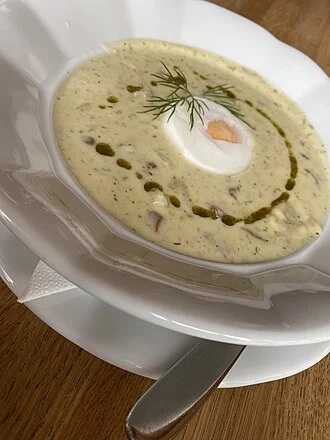
Kulajda Soup
Kulajda
KOO-lah-dah
A creamy dill and mushroom soup with a poached egg.
Open Kulajda Soup recipe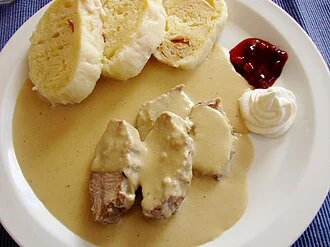
Main course
Meat
Roast Duck with Cabbage and Dumplings
Pečená kachna s zelím a knedlíky
PEH-cheh-nah KAHCH-nah s ZEHL-yeem a KNED-leek-ee
A classic Czech main with roasted duck, braised cabbage, and bread dumplings.
Open Roast Duck with Cabbage and Dumplings recipe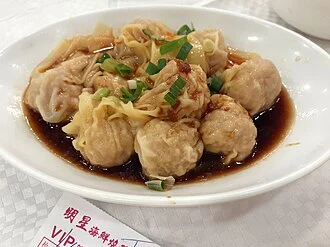
Main course
Vegetarian
Carlsbad Dumplings
Karlovarské knedlíky
KAR-lo-var-skeh kned-leh-kee
Bread dumplings typical of the Carlsbad region.
Open Carlsbad Dumplings recipe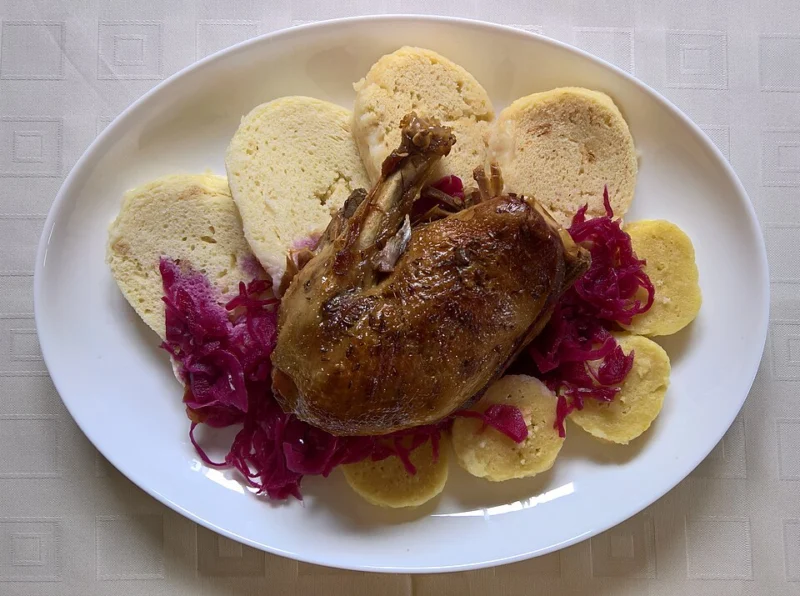
Main course
Meat
Duck with Cabbage and Dumplings
Kachna se zelím a knedlíky
KAKH-na seh ZEHL-eem ah KNEHD-lee-kee
Traditionally roasted duck served with red cabbage and bread dumplings.
Open Duck with Cabbage and Dumplings recipe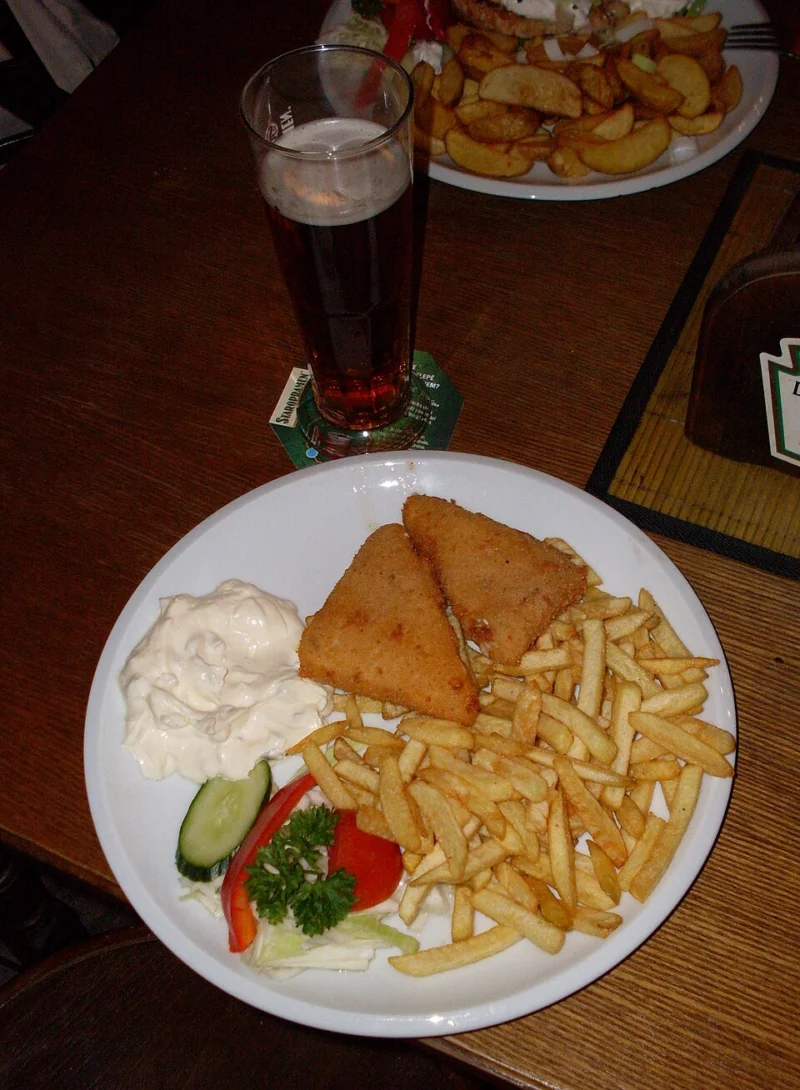
Snack
Vegetarian
Czech Beer Cheese
Pivní sýr
PIV-nee seer
Fermented cheese typically served with bread and beer.
Open Czech Beer Cheese recipe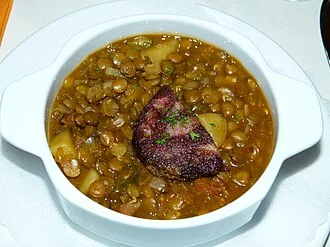
Soup
Vegan
Czech Lentil Soup
Čočková polévka
CHOCH-koh-vah po-LEV-kah
A hearty soup made from lentils, vegetables, and spices.
Open Czech Lentil Soup recipe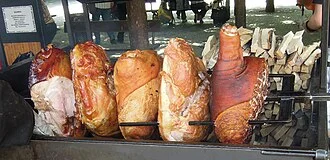
Main course
Meat
Prague Ham
Pražská šunka
PRAJ-skah SHOON-ka
Lightly smoked and brined ham from Prague.
Open Prague Ham recipe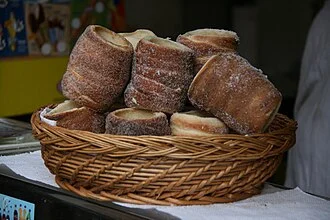
Dessert
Vegetarian
Chimney Cake
Trdelník
TUR-del-neek
Sweet pastry made from rolled dough, cinnamon and sugar.
Open Chimney Cake recipe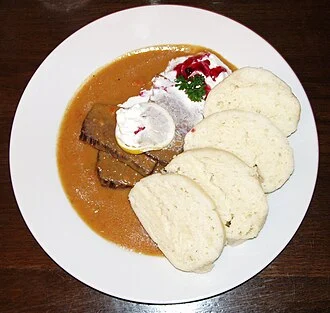
Main course
Meat
Beef with Cream Sauce and Dumplings
Svíčková na smetaně
SVEE-chko-vah nah smeh-TAHN-yeh
A traditional Czech dish of marinated beef served with a rich cream sauce and dumplings.
Open Beef with Cream Sauce and Dumplings recipe🌿
Dessert
Vegetarian
Blueberry Dumplings
Borůvkové knedlíky
bo-roov-koh-ve kned-lee-kee
Sweet boiled dumplings stuffed with blueberries.
Open Blueberry Dumplings recipe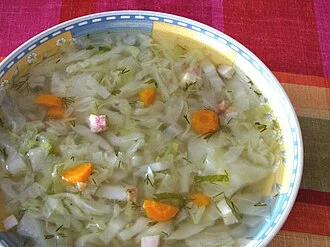
Soup
Meat
Old Bohemian Cabbage Soup
Staroceska zelňačka
STA-ro-ches-kah ZELL-nyah-chka
Rich and sour soup with cabbage and smoked meat.
Open Old Bohemian Cabbage Soup recipe
Dessert
Vegetarian
Honey Cake
Medovník
meh-DOV-neek
Layered cake made with honey and cream filling.
Open Honey Cake recipe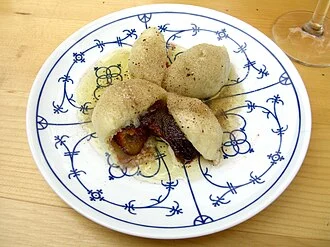
Dessert
Vegetarian
Fruit Dumplings
Ovocné knedlíky
O-vo-tsneh kneh-dlee-kee
Sweet dumplings filled with fruit, typically served with butter and sugar.
Open Fruit Dumplings recipe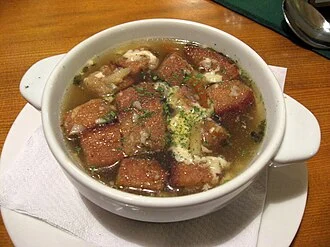
Soup
Vegetarian
Garlic Soup
Česnečka
CHES-nech-ka
A warming soup made of garlic, potatoes, and sometimes egg.
Open Garlic Soup recipe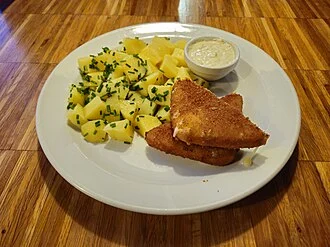
Main course
Vegetarian
Fried Cheese
Smažený sýr
SMA-zheh-nee SEER
Deep-fried breaded cheese served with tartar sauce and potatoes.
Open Fried Cheese recipe