

Explore Guides
OCEANIA / FIJI
Triplandio Nadi guide covers 3 travel guides across 12 areas, complete with hotel picks. Explore 9 self-guided walking tours in Nadi with 17 POI, spanning 40.4 km in total. Get inspired by 6 local dishes, complete with recipes and our unique Food Flavour DNA graph.
Nadi
City & Country Data Nadi (Fiji)

Key travel data for Nadi — local prices, safety, healthcare, local currency and essentials, curated by Triplandio.
🌍 Fiji
Safety
63
Health
21
Lifestyle
65
Infra
11
Rank
#87
Score
23
Tourists
168K/y
GDP/cap
$6.6k
Life Exp
67.5 yrs
Population
933.2K
Currency
FJD FJ$
Language
English
Payments
Cash only
Emergency
911
💰 Prices in Nadi
Coffee
$3.90
Beer
$3.00
Lunch
$4.90
Groceries
$50.00/w
Taxi/km
$0.45
Transit
$0.70
Fuel
$1.30/l
Internet
$22.50/m
Salary
$1,100/m
Travel tipsNadi (Fiji)

Quick tips
- Any amount of marijuana means prison — Critical
In Fiji, possessing any amount of marijuana carries a 3-month prison sentence, and even small quantities of other drugs can bring prison and a large fine.
- Topless bathing is illegal — Caution
Nudity and topless sunbathing in public are against the law in Fiji, including on beaches. Keep swimwear to the beach and pool, and cover up elsewhere.
- Fresh food is confiscated on arrival — Caution
Fiji has strict quarantine rules, and customs X-ray all luggage at Nadi airport. Most fresh food is confiscated, so declare anything you carry.
- Cyclone season is November to April — Caution
Tropical cyclones hit Fiji mainly between November and April, bringing floods, landslides and cancelled flights and ferries. Follow the Fiji Meteorological Service and your resort's instructions.
- Cover shoulders and knees in villages — Local tip
When visiting a Fijian village or joining a kava ceremony, cover your shoulders and knees; a sarong (sulu) works for everyone. Remove hats and sunglasses in the village.
- Do
- Bring kava roots when visiting a village
- Use taxis with yellow plates
- Cover shoulders and knees in villages
- Check the dive operator's credentials
- Wear reef shoes
- Don’t
- Bring any marijuana
- Sunbathe topless
- Touch anyone's head
- Wear a hat in a village
- Board an overloaded boat
Critical
Prison or heavy penalty possible
Health
- Only one recompression chamber — Critical
Fiji's only hyperbaric (recompression) chamber, in Suva, is not always working. Check its status before diving and make sure your insurance covers dive accidents.
- Methanol in spirits — Critical
Methanol-contaminated spirits have caused deaths in travel destinations worldwide. In Fiji, drink sealed, branded alcohol and seek help fast if you feel unwell after drinking.
Beaches & adventure
- Avoid overloaded boats — Critical
Inter-island boats in Fiji can be overloaded, and some have capsized in bad weather. Don't board if there aren't enough life jackets for everyone.
Caution
Fines, losses or injury possible
Scams & safety
- The name-carving ‘sword seller’ — Caution
Friendly men in Nadi town ask your name, carve it into a wooden souvenir such as a sword or mask, then pressure you to pay for it. Don't give your name and keep walking.
Laws & fines
- Use taxis with yellow plates — Caution
Licensed taxis and minibuses in Fiji have yellow registration plates. Unlicensed minibuses are often uninsured, so avoid them.
- Declare 10,000 Fijian dollars or more — Caution
Cash in any currency worth 10,000 Fijian dollars or more must be declared when entering or leaving Fiji. Undeclared cash can lead to a fine or prison.
Tipping & money
- Use ANZ or Westpac ATMs — Caution
Not all ATMs in Fiji accept foreign cards. ANZ (Australia and New Zealand Banking Group) and Westpac machines accept Visa, Mastercard, Maestro and Cirrus. Watch for card skimmers and cover the keypad.
Beaches & adventure
- Rip currents at reefs and river mouths — Caution
Strong rip currents run through reef passages and river estuaries in Fiji. Swim where there are lifeguards or with reliable local advice, and follow the flags.
- Check dive and boat operators — Caution
Some dive schools and boat operators in Fiji skimp on safety. Ask to see credentials, check equipment and life jackets, and make sure oxygen is on board.
Good to know
Rules and useful facts
Scams & safety
- Travel advisory: Level 1 of 4 — Good to know
Exercise Normal Precautions — the U.S. State Department's rating for Fiji.
- Walking at night — Good to know
Nadi town is quiet and poorly lit after dark, and there have been assaults on foreigners in Fiji, particularly women walking alone. Take a licensed taxi back to your hotel at night.
Laws & fines
- Register a local SIM card — Good to know
Fijian SIM cards, sold at Nadi Airport and in shops, must be registered with ID when you buy them. Your home phone plan may not roam in Fiji, and coverage on outer islands is patchy.
- Avoid protests — Good to know
Demonstrations in Fiji can start with little warning. Keep away from rallies and any area with obvious military or police activity.
Entry & visa
- Visa-free for up to 4 months — Good to know
Visitors from many countries, including the UK, can visit Fiji without a visa for up to 4 months. Check the rules for your own passport before travelling.
- Passport valid for 6 months — Good to know
Your passport must be valid for at least 6 months after the date you arrive in Fiji.
- Onward ticket and next visa — Good to know
Fijian border officers ask for a return or onward ticket and, if needed, a valid visa for the next country you are travelling to.
- Yellow fever certificate if needed — Good to know
Fiji requires a yellow fever vaccination certificate if you arrive from a country with a risk of yellow fever transmission.
Health
- Dengue, Zika and chikungunya — Good to know
Mosquitoes in Fiji spread dengue, Zika and chikungunya, especially in the wet season. Use repellent day and night; there is no malaria in Fiji.
- Hospitals want cash up front — Good to know
Healthcare in Fiji is limited and hospitals usually ask for immediate cash payment. Serious cases are flown abroad, so get insurance that covers evacuation. Ambulance: dial 911.
- Reef fish poisoning — Good to know
Some large reef fish in Fiji can carry ciguatera, a toxin that causes vomiting and tingling and isn't destroyed by cooking. Ask locals which fish are safe to eat.
- Drinking water — Good to know
Tap water at major resorts and in Nadi and Suva is usually treated, but on outer islands and in villages drink bottled or boiled water.
Beaches & adventure
- Coral cuts and jellyfish — Good to know
Coral cuts in Fiji infect easily in the tropical heat. Wear reef shoes, clean any cut straight away and follow local advice on jellyfish.
- Earthquakes and tsunami alerts — Good to know
Fiji lies in an earthquake zone. If you feel a strong quake on the coast or hear a tsunami alert, move to high ground immediately.
Local tips
Local know-how
Scams & safety
- ‘Free kava’ shop invitations — Local tip
Touts on Nadi's main street invite visitors into handicraft shops for a free kava drink, followed by hard selling. Say no politely if you don't want to shop.
Getting around
- Nadi Airport (NAN) to town and Denarau — Local tip
Nadi International Airport is about 10 km north of Nadi town. A licensed taxi takes about 15 minutes to town and about 20–30 minutes to the Denarau resorts; many hotels offer transfers.
- Only yellow-plated taxis — Local tip
Licensed taxis in Nadi have yellow number plates. Agree the fare before you set off if the driver doesn't use the meter.
- Boats from Port Denarau — Local tip
Ferries and catamarans to the Mamanuca and Yasawa islands leave from Port Denarau, west of Nadi town. Hotel pick-ups for early departures are usually available.
- Local buses — Local tip
Cheap local buses run between Nadi town, the airport and Denarau during the day. They are open-sided and slow but safe; carry small change.
Customs
- Bring a sevusevu gift to a village — Local tip
When you visit a Fijian village, it is customary to present a gift, usually dried kava roots (yaqona), to the chief in a small welcome ceremony called sevusevu. Tour guides can arrange this for you.
- Never touch someone's head — Local tip
In Fijian culture the head is sacred. Don't touch anyone's head, including children's, and take off your hat in villages.
- Kava ceremony etiquette — Local tip
Kava is a mildly numbing drink made from a root. In a ceremony, clap once and say ‘bula’ before taking the bowl, drink it in one go and hand it back. It can harm the liver in large amounts.
- Shoes off indoors — Local tip
Take off your shoes before entering a home, a village meeting house or a church in Fiji, and sit cross-legged on the mat.
- Quiet Sundays — Local tip
Sunday is a day of church and rest in much of Fiji. Villages are quiet, some shops close, and swimming or noisy activities near villages may be frowned on.
Tipping & money
- Tipping is not expected — Local tip
Tipping is not part of Fijian culture. Many resorts have a staff Christmas fund box at reception, which is the best way to thank the whole team.
- Cards at resorts, cash elsewhere — Local tip
Most tourist hotels and many restaurants take credit cards, but villages, markets and buses need Fijian dollars (FJD) in cash.
- Gentle bargaining at craft markets — Local tip
Prices in shops and markets for food are fixed. At handicraft stalls a polite request for a better price is fine, but hard haggling is not the Fijian way.
Say it locally
English is widely spoken, but a warm “bula” and “vinaka” are used by everyone; in Fijian, “c” is said like “th”.
Through the year
Festival or season Public holiday (exact date)
- Cyclone and wet season
Nov 2026–Apr 2027 · Hot, humid and rainy, with the highest cyclone risk; prices are lower but boat trips can be cancelled.
- Diwali
Mon 9 Nov 2026 · Public holiday
- Australian and New Zealand school holidays
Dec 2026–Jan 2027, Jun–Jul 2027 · Family resorts in the Mamanuca Islands and on the Coral Coast fill up; book early.
- Christmas Day
Fri 25 Dec 2026 · Public holiday
- Boxing Day
Sat 26 Dec 2026 · Public holiday
- New Year
Fri 1 Jan 2027 · Public holiday
- Good Friday
Fri 26 Mar 2027 · Public holiday
- Holy Saturday
Sat 27 Mar 2027 · Public holiday
- Easter Monday
Mon 29 Mar 2027 · Public holiday
- Dry season
May–Oct 2027 · Cooler, drier and sunnier, with the best visibility for diving; resorts are busiest and priciest.
- Bula Festival
Jul 2027 · Nadi's week-long town festival with rides, food stalls and cultural performances, usually held in July.
- Hibiscus Festival
Aug 2027 · Suva's week-long carnival with parades, food stalls and the Hibiscus pageant, held in August.
- The Prophet's Birthday Holiday (tentative)
Sun 15 Aug 2027 · Public holiday
- Fiji Day
Sun 10 Oct 2027 · Public holiday
Sources: GOV.UK travel advice · U.S. State Dept · Google public holidays
Best time to visit Nadi (Fiji)
Now (November) avg high: 30°C, wetter month, full season — expect crowds. Best months to walk: Sep & Oct.
Live Temp
…
~Day / Night Temp
30°C / 23°C
Sunrise / Sunset
5:29 / 18:19
Local time
4:49
Sea Temp
29°C
Best Months  Sep & Oct
J
Jan
F
Feb
M
Mar
A
Apr
M
May
J
Jun
J
Jul
A
Aug
S
Sep
O
Oct
N
Nov
 D
Dec
O
Oct
N
Nov
D
Dec
Check Nadi hotels
Temperature
Average daytime high, month by month. Zero line marks freezing point.
Crowds
How busy it gets — traveller interest by month.
Sea temperature
Sea warmth for swimming, by month.
Rainfall
Rainy days to expect each month.
Sunshine
Hours of sun per day, by month.
Soft flatbread made with mashed sweet potatoes. A spicy fish stew simmered in fragrant curry spices. A traditional Fijian earth oven meal featuring meats, vegetables, and coconut. A seasoned coconut milk sauce typically served with seafood. Taro leaves baked in coconut cream. Traditional dessert made from cassava and coconut flavorings. A sweet pudding made of coconut and cassava.
Traditional Local Food
Nadi (Fiji)
🌿
Bread
Vegetarian
Fijian Sweet Potato Roti
Roti ni Kūmala
fee-jian sweet po-tay-to roh-tee
· Roti with sweet potato
🐟
Main course
Fish & Seafood
Fish Suruwa
Suruwa ni Ika
feesh soo-roo-wah
· Curried fish stew
🥩
Main course
Meat
Lovo
Lo-vo
· Earth oven feast
🌱
Starter
Vegan
Miti
mee-tee
· Coconut milk dipping sauce
 Main course
Vegetarian
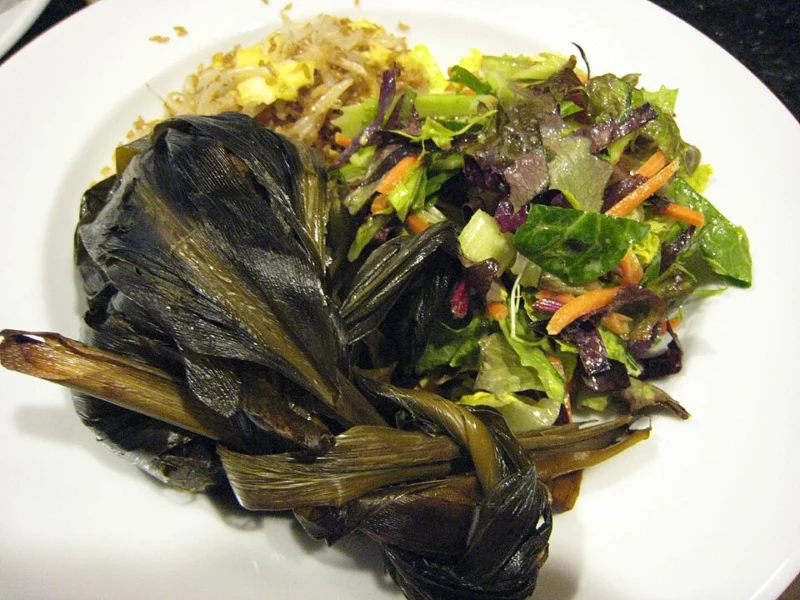
Palusami
pah-loo-sah-mee
· Taro leaves with coconut cream
🌿
Dessert
Vegetarian
Tavioka Vakalolo
Vakalolo ni Tavioka
tah-vee-oh-kah vah-kah-loh-loh
· Cassava dessert pudding
🌿
Dessert
Vegetarian
Vakalolo
Va-ka-lo-lo
· Steamed coconut pudding