

Explore Guides
CARIBBEAN
Dominican Republic
Triplandio Dominican Republic guide covers 2 travel guides with 1 city across 8 areas, complete with hotel picks. Explore 8 self-guided walking tours in Dominican Republic with 27 POI, spanning 31 km in total. Get inspired by 5 local dishes, complete with recipes and our unique Food Flavour DNA graph.
Country Data Dominican Republic

Key travel data for Dominican Republic — safety, healthcare, local currency and essentials, curated by Triplandio.
🌍 Dominican Republic
Safety
50
Health
34
Lifestyle
53
Infra
30
Rank
#79
Score
30
Tourists
2.7M/y
GDP/cap
$11.1k
Life Exp
73.9 yrs
Population
11.5M
Currency
DOP RD$
Language
Spanish
Payments
Mixed
Emergency
112
Travel tipsDominican Republic

Quick tips
- Drivers in injury accidents are detained — Critical
In the Dominican Republic, a driver involved in an accident causing serious injury or death is held in police custody during the investigation, even if not at fault. Think twice before driving yourself.
- Unpaid hospital bills can stop you leaving — Critical
Visitors who can't pay private hospital bills in the Dominican Republic have been stopped from leaving the country until the debt is settled. Travel insurance with high medical cover is essential.
- Motorbike thieves target phones and bags — Critical
Crime is high in the Dominican Republic. Thieves on motorcycles snatch bags and phones and reach into cars at red lights, and muggers may be armed even in daytime. Keep valuables hidden and never fight back.
- Never pay traffic fines to police in cash — Caution
Dominican police can issue fines for traffic violations but should not ask you for money. Pay any fine online through the official traffic fines (Infracciones de tránsito) website.
- Fill in the online entry and exit form — Good to know
Every visitor must complete the Dominican Republic's online entry and exit form (E-Ticket) within 7 days before arriving and again before leaving. Keep the QR code to show at check-in and at the border.
- Choose your coast — Local tip
Punta Cana and the east have the big all-inclusive resorts, the north coast around Puerto Plata and Cabarete has water sports, and Samaná has quieter beaches and whales in winter.
- Do
- Complete the online E-Ticket form
- Carry a copy of your passport
- Use registered taxis or apps
- Swim where warning flags are shown
- Buy insurance with high medical cover
- Don’t
- Drink tap water
- Ride a motoconcho
- Drive outside cities at night
- Hand cash to police for a fine
- Carry anything for someone else
Critical
Prison or heavy penalty possible
Laws & fines
- Drug penalties are severe — Critical
Possession of even small amounts of any drug in the Dominican Republic can mean prison, and cases can take years to reach trial while you are held. Pack your own bags.
Customs
- Be wary of friendly strangers — Critical
Sexual assaults against visitors have happened, including at resorts. Don't walk alone at night, don't accept rides or invitations from strangers and watch your drink.
Caution
Fines, losses or injury possible
Getting between cities
- Avoid shared cars and minibuses — Caution
Local minibuses (guaguas) and shared cars (carros públicos) are cheap but often unregistered, uninsured and poorly maintained. Use coaches or taxis instead.
- Driving is risky — Caution
Traffic drives on the right, but drivers often weave between lanes without signalling and drink-driving is common. Most motorways between tourist areas are in good condition.
Tipping & money
- Card cloning — Caution
Card cloning and identity theft are a risk in the Dominican Republic. Keep your card in sight when paying, use ATMs inside banks or malls, or pay in cash.
Health
- Research cosmetic surgery carefully — Caution
Many visitors travel to the Dominican Republic for cosmetic surgery. Check the surgeon's qualifications and discuss the risks with your own doctor before booking.
Beaches & adventure
- Beaches often have no lifeguards — Caution
Many Dominican beaches and hotel pools have no lifeguard or rescue equipment, and currents can be strong, especially in hurricane season. Follow warning flags.
- Check tour safety standards — Caution
Boat trips, quad biking, zip-lines and horse riding may not meet international safety standards. Use reputable operators, ask about life jackets and helmets, and check your insurance.
- Avoid motorbike taxis — Caution
Motorbike taxis (motoconchos) are often driven badly, rarely provide helmets and are involved in many fatal accidents. Use registered taxis or ride-hailing apps.
- Don't drive at night — Caution
Rural roads at night have poor lighting, animals, pedestrians and cars without headlights. Plan long drives to finish before dark.
- Scooters are high-risk — Caution
The Dominican Republic has a high death rate from motorbike and scooter crashes. If you do ride, wear a helmet, avoid night riding and check that your insurance covers you.
Good to know
Rules and useful facts
Getting between cities
- Check your licence before driving — Good to know
Visitors from the UK can drive in the Dominican Republic on their photocard licence for up to 3 months, but hire firms often also want an International Driving Permit (IDP), a year's experience and a higher minimum age.
Regions & seasons
- East coast: resorts and sargassum — Good to know
Punta Cana and Bávaro have long beaches and all-inclusive hotels. Seaweed can arrive in the warmer months, so check recent beach reports.
Laws & fines
- Carry a passport copy — Good to know
Always carry a copy of your passport's photo page and your entry stamp in the Dominican Republic, and keep the original in your hotel safe.
- Report crimes before you leave — Good to know
A crime must be formally reported to the Dominican police before you leave the country, or it can't be investigated. Tourist police (Politur) help visitors in resort areas.
- Reporting road accidents — Good to know
Every road accident in the Dominican Republic must be reported. Minor ones in Santo Domingo or Santiago go to official accident-reporting centres; elsewhere, go to the nearest police station.
- Conservative attitudes to LGBT+ travellers — Good to know
Same-sex relationships are legal in the Dominican Republic but not recognised, and public affection can draw hostile attention. Most resorts welcome LGBT+ guests.
Entry & visa
- Travel advisory: Level 2 of 4 — Good to know
Exercise increased caution — the U.S. State Department's rating for Dominican Republic.
- Visa-free for 30 days — Good to know
Many visitors, including UK, EU and US citizens, can stay 30 days for tourism without a visa. You can pay the immigration service to extend your stay up to 120 days.
- Show a return ticket — Good to know
Border officers may refuse entry if you can't show a return or onward ticket. Your fingerprints and photo are taken on arrival.
- Children travelling alone — Good to know
Children aged 17 and under travelling alone or with one parent may need extra documents. Check with the airline and the Dominican immigration service before booking.
- Yellow fever certificate if coming from a risk country — Good to know
You may need a yellow fever vaccination certificate if you arrive from a country where the disease is present. Check before you travel.
- Passport valid for your whole stay — Good to know
Until 31 December 2026, British visitors only need a passport valid for the whole stay in the Dominican Republic. Rules may change after that, and other nationalities may need longer validity, so check before booking.
Health
- Don't drink the tap water — Good to know
Tap water in the Dominican Republic is not safe to drink. Use bottled or purified water, including for brushing teeth if you have a sensitive stomach.
- Emergency numbers — Good to know
Call 911 for an ambulance in Santo Domingo; coverage elsewhere is patchy. Outside the capital, call the tourist police (Politur) on +1 809 200 3500.
- Mosquito-borne diseases — Good to know
Dengue, Oropouche virus and malaria occur in the Dominican Republic. Use repellent day and night, and see a doctor if you develop a fever.
- Private hospitals are expensive — Good to know
Public hospitals in the Dominican Republic are limited; private ones are good but costly. Carry your insurance details and contact your insurer before treatment.
Beaches & adventure
- Earthquakes and tsunamis — Good to know
Earthquakes can happen in the Dominican Republic, and a strong quake at sea could cause a tsunami. Learn your hotel's evacuation route and move to high ground if told to.
Local tips
Local know-how
Getting between cities
- Private coach companies — Local tip
Private bus companies such as Caribe Tours and Metro Tours run comfortable, air-conditioned coaches between Santo Domingo, Santiago, Puerto Plata, Samaná and other towns.
- Taxis and ride-hailing — Local tip
Use authorised airport or hotel taxis, or ride-hailing apps such as Uber in Santo Domingo and Santiago. Many street taxis are in poor condition.
Regions & seasons
- Santo Domingo's colonial zone — Local tip
The capital's Zona Colonial has the oldest European buildings in the Americas and is best explored on foot in the cooler morning hours.
- Mountains in the centre — Local tip
Jarabacoa and Constanza in the central mountains are much cooler than the coast, especially at night. Pico Duarte, the Caribbean's highest peak, is a multi-day guided hike.
Customs
- Say hello first — Local tip
Dominicans greet each other warmly, and it's polite to say “Buenos días” or “Buenas” before asking a question in a shop, bus or street stall.
- Beachwear stays at the beach — Local tip
Swimwear is fine at resorts and beaches, but in towns, churches and government offices Dominicans expect shirts and longer shorts or trousers.
- Relaxed timekeeping — Local tip
Social events and some tours in the Dominican Republic start later than planned. Allow extra time, but be punctual for flights, buses and formal meetings.
Tipping & money
- Service is on the bill — tip a little extra — Local tip
Dominican restaurant bills include a 10% legal service charge and 18% sales tax (ITBIS). Leaving about 10% more in cash for good service is customary.
- Pesos or US dollars — Local tip
The currency is the Dominican peso (DOP). US dollars are widely accepted in resorts and tourist areas, but you usually get a better price paying in pesos.
- Bargain with beach vendors — Local tip
Haggling is expected with beach vendors, market stalls and unmetered taxis. Agree the price before any service, such as a boat trip or taxi ride.
Our Dominican Republic city guides
Come January to March for humpback whales; book boat trips with licensed whale-watching operators.
Say it locally
Dominicans speak fast and often drop the final “s”; a friendly “Buenas” works as hello any time of day.
Through the year
Festival or season Public holiday (exact date)
- Hurricane season
Jun–Nov 2026 · Storms are most likely August–October and have mainly affected the north and east; follow the civil protection app AlertaCOE.
- Constitution Day
Sat 6 Nov 2027 · Public holiday
- Dry high season
Dec 2026–Apr 2027 · Sunny, less humid weather and the most visitors; resort prices peak around Christmas, New Year and Easter.
- Christmas Day
Fri 25 Dec 2026 · Public holiday
- New Year's Day
Fri 1 Jan 2027 · Public holiday
- Epiphany
Mon 4 Jan 2027 · Public holiday
- Our Lady of Altagracia
Thu 21 Jan 2027 · Public holiday
- Duarte's Day
Tue 26 Jan 2027 · Public holiday
- Carnival
Feb 2027 · Every Sunday in February towns hold carnival parades, the most famous in La Vega, with masked devils (diablos cojuelos) swinging inflated bladders.
- Independence Day
Sat 27 Feb 2027 · Public holiday
- Holy Week (Semana Santa)
Mar–Apr 2027 · Dominicans head for beaches and rivers in the week before Easter; roads are crowded, accidents rise and some businesses close.
- Good Friday
Fri 26 Mar 2027 · Public holiday
- Sargassum seaweed
Apr–Sep 2027 · Large mats of brown seaweed can wash up on east- and south-facing beaches in the warmer months; many resorts clear it daily.
- Labor Day
Sat 1 May 2027 · Public holiday
- Corpus Christi
Thu 27 May 2027 · Public holiday
- Restoration Day
Mon 16 Aug 2027 · Public holiday
- Feast of Our Lady of Mercy
Fri 24 Sep 2027 · Public holiday
Sources: GOV.UK travel advice · U.S. State Dept · Google public holidays
Traditional Local Food Dominican Republic
🥩
Street food
Meat
Pasteles en Hoja
Pahs-teh-lehs ehn Oh-ha
· Plantain leaf-wrapped pastries
Plantain dough filled with meats and vegetables, wrapped and boiled.
Open Pasteles en Hoja recipe🐟
Main course
Fish & Seafood
Pescado con Coco
Pehs-kah-doh kohn Koh-koh
· Fish with coconut sauce
A traditional fish dish cooked in creamy coconut sauce.
Open Pescado con Coco recipe
Dessert
Vegetarian
Habichuelas con Dulce
Ah-bee-chew-eh-las kohn Dool-seh
· Sweet cream of beans
Sweet dessert made from red beans and coconut.
Open Habichuelas con Dulce recipe🥩
Soup
Meat
Bouillon de Chivo
Boo-yon deh Chee-vo
· Goat soup
A hearty soup of goat meat and local spices.
Open Bouillon de Chivo recipe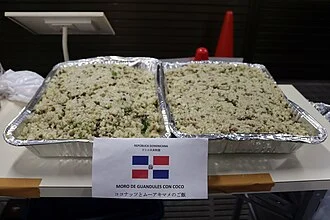
Main course
Vegetarian
Moro de Guandules con Coco
Moh-roh deh Gwan-doo-lays kohn Koh-ko
· Rice with pigeon peas and coconut
Samaná's fragrant rice and pigeon peas cooked in coconut milk.
Open Moro de Guandules con Coco recipe